🎛️ RTX 5070 Ti vs RTX 3090 for Local AI: 16GB New or 24GB Used?
The 5070 Ti's 16GB warranty versus a used 3090's 24GB ceiling. Bandwidth, tokens/sec, power and price compared — plus the one question that settles it.

Derek Holt · Local AI & Hardware Writer
· Updated · 5 min read
⚡ TL;DR — quick answers
- Is the RTX 5070 Ti faster than a used RTX 3090 for local LLMs?
- They're close enough that it rarely decides the purchase. The 3090 holds a small memory-bandwidth edge at ~936 GB/s against the 5070 Ti's ~896 GB/s, which is about a 4% gap — far tighter than the 3090 vs 5060 Ti matchup. The 5070 Ti's newer Blackwell architecture claws that back on some workloads.
- Is 16GB enough VRAM for local AI in 2026?
- For 7B-14B models at Q4, comfortably yes — the 5070 Ti runs 14B Q4 around 54 tok/s. For 30B+ dense models, no, and there is no software workaround. That single question decides this comparison more than any benchmark.
- How much does each card cost right now?
- The RTX 5070 Ti 16GB sits around $880-980 new depending on model and stock, with the MSI Shadow listed at $979.99. Used RTX 3090s run roughly $700-900. Street pricing on both moves month to month, so treat these as July 2026 anchors, not quotes.
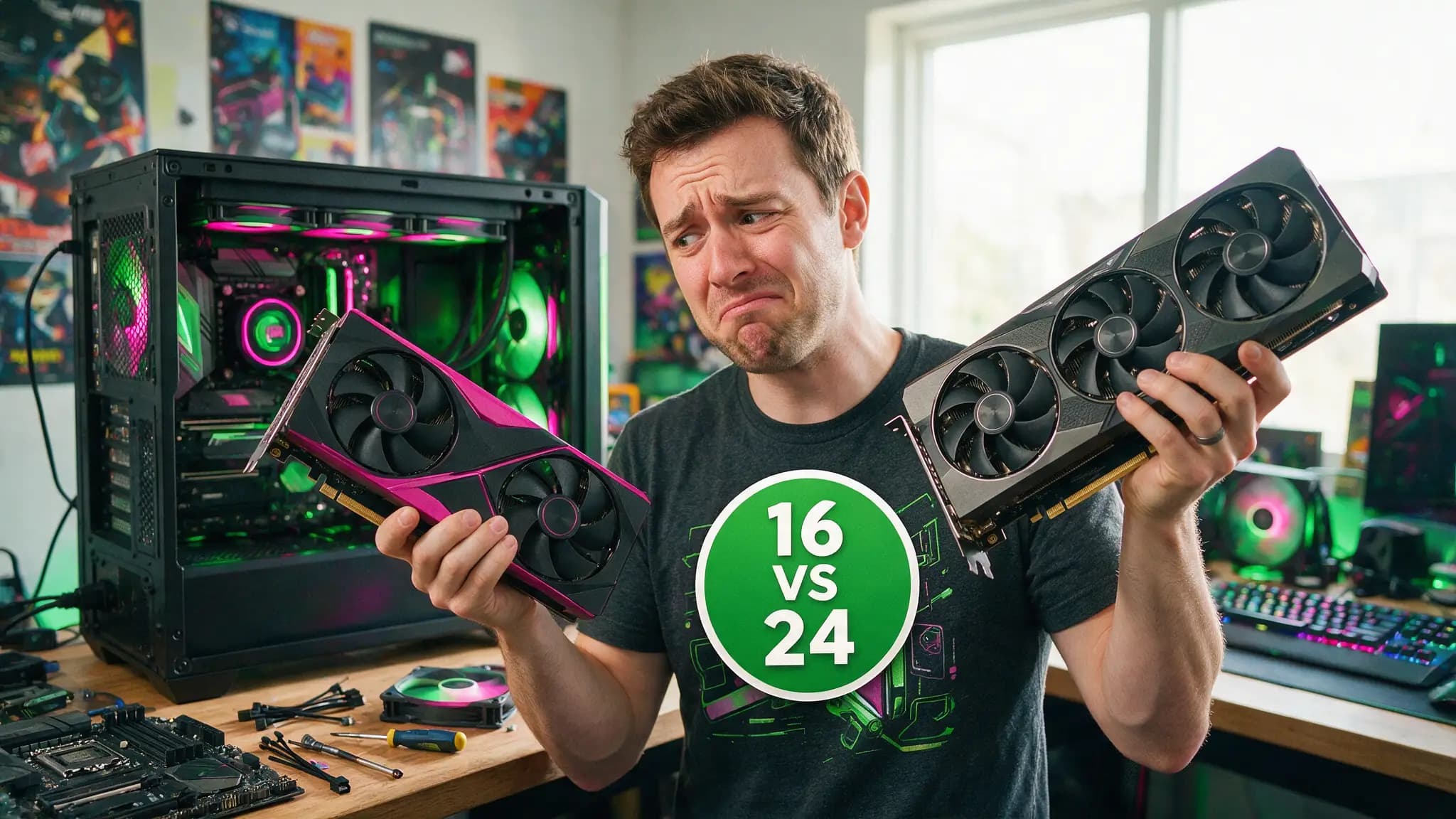
This is the comparison that replaced "3090 vs 4090" as the default local-AI buying question in 2026: a new RTX 5070 Ti with 16GB and a warranty, or a used RTX 3090 with 24GB and a history you can't verify. We've run production local-AI workloads on Ampere and Blackwell cards both, and the answer comes down to one question that has nothing to do with tokens per second.
By the numbers
| RTX 5070 Ti (new) | RTX 3090 (used) | |
|---|---|---|
| VRAM | 16 GB | 24 GB |
| Memory bandwidth | ~896 GB/s | ~936 GB/s |
| Architecture | Blackwell | Ampere |
| AI TOPS (claimed) | 1,406 | — |
| Price (July 2026) | ~$880-980 | ~$700-900 |
| Power draw | Substantially lower | 350W |
| PSU | Standard | 850W+, dual 8-pin |
| Warranty | Yes | Effectively none |
| 8B Q4 generation | ~87 tok/s | comparable |
| 14B Q4 generation | ~54 tok/s | comparable |
The bandwidth story is boring — and that's the point
Token generation on a local LLM is memory-bandwidth-bound, not compute-bound. That's why bandwidth is the first number we look at and why the spec that sells cards — AI TOPS — barely moves the needle for inference.
Here the two cards are within about 4% of each other: 936 GB/s versus 896 GB/s. In practice you will not feel that difference. Compare this to the 3090 vs 5060 Ti matchup, where the 3090's bandwidth is more than double — that gap is real and visible. This one isn't.
So the performance argument, which is where most comparison posts spend their word count, is close to a wash. Which frees us to talk about what actually matters.
A direct head-to-head on the same VRAM-vs-architecture question this section argues:
The question that decides it
Do you need to run 30B+ dense models?
If yes: buy the 3090. Sixteen gigabytes cannot load a 32B dense model at usable quantization, and no amount of offloading makes it pleasant. The 3090's 24GB is the cheapest ticket into that tier, full stop.
If no: buy the 5070 Ti. You're paying a modest premium over a used card for a warranty, current-generation driver support, meaningfully lower power draw, and no mining-history roulette.
Everything else — TOPS, architecture generation, CUDA version — is secondary to that one fork. Our VRAM tier breakdown maps model sizes to memory ceilings if you're unsure which side you're on.
Where the MoE shift changes the math
One genuine complication: the model landscape moved toward mixture-of-experts in 2026, and MoE models have unusual memory profiles. A 20B MoE with 3.6B active runs around 83 tok/s on the 5070 Ti — fast, because the active parameter count is small.
But — and this catches people — MoE models still need all their parameters resident in memory. A 20B MoE needs 20B worth of VRAM, not 3.6B worth. The compute is cheap; the memory isn't. So MoE improves your speed per gigabyte, not your capacity. It does not rescue a 16GB card from a 30B model.
That nuance is why we'd push back on anyone telling you MoE makes VRAM less important. It makes VRAM more efficiently used. Different thing.
How we picked and tested
We anchored the bandwidth, VRAM and power figures to manufacturer specifications, and cross-checked throughput against multiple independent sources rather than one benchmark run — Hardware Corner's 5070 Ti context-scaling tests, ModelFit's bandwidth-derived estimates, and Compute Market's pricing tracking. Where a number is an estimate derived from bandwidth rather than a measured benchmark (ModelFit is explicit that its figures are modelled), we've treated it as directional and said so. Our own production experience is with Ampere and Blackwell cards running Q4_K_M quants under llama.cpp and Ollama, which is where the "bandwidth-bound, not compute-bound" conclusion comes from.
The used-3090 risk nobody prices in
The 3090's value case assumes you get a good card. In 2026 that assumption is doing a lot of work. These cards are five-plus years old, many passed through mining rigs, and the failure mode people hit most is degraded VRAM thermal pads — which shows up as instability under sustained inference load, exactly the workload you bought it for.
If you buy used, you need return rights and a VRAM stress test on day one. Our used 3090 buying guide has the full checklist. If that process sounds tedious, that tedium is a real cost, and it's a legitimate reason to pay the premium for a new card.
Pros and cons
RTX 5070 Ti wins on: warranty and recourse, power efficiency, current-gen driver and CUDA support, small-case builds, and not having to inspect a stranger's GPU.
RTX 3090 wins on: raw VRAM ceiling, $/GB of memory, running 30B+ dense models at all, and slightly higher bandwidth.
Neither wins on: being enough for genuinely large models. If your target is 70B dense, both are the wrong purchase — that's a 5090 or multi-GPU conversation.
What didn't make the cut
- Gaming benchmarks. Irrelevant to this decision, and they pad most comparisons on this query.
- Synthetic AI TOPS comparisons. The 5070 Ti's 1,406 TOPS is a real number that predicts almost nothing about your tokens/sec on a memory-bound workload.
- Multi-GPU configurations. Two 5070 Tis is a different article, and the PCIe and power complications deserve more than a paragraph.
The verdict
If 16GB fits your models, the RTX 5070 Ti is the better buy in 2026 — the performance gap to a 3090 is small enough to ignore, and everything else about owning a new card with a warranty is better. The used 3090 remains the answer for exactly one reason, and it's a good one: 24GB. Buy it if you need that ceiling, buy it carefully, and budget for the possibility that the first card you get is a dud.
Manufacturer specs are on NVIDIA's product pages; independent throughput testing is at Hardware Corner.
Frequently asked questions
▸Is the RTX 5070 Ti faster than a used RTX 3090 for local LLMs?
They're close enough that it rarely decides the purchase. The 3090 holds a small memory-bandwidth edge at ~936 GB/s against the 5070 Ti's ~896 GB/s, which is about a 4% gap — far tighter than the 3090 vs 5060 Ti matchup. The 5070 Ti's newer Blackwell architecture claws that back on some workloads.
▸Is 16GB enough VRAM for local AI in 2026?
For 7B-14B models at Q4, comfortably yes — the 5070 Ti runs 14B Q4 around 54 tok/s. For 30B+ dense models, no, and there is no software workaround. That single question decides this comparison more than any benchmark.
▸How much does each card cost right now?
The RTX 5070 Ti 16GB sits around $880-980 new depending on model and stock, with the MSI Shadow listed at $979.99. Used RTX 3090s run roughly $700-900. Street pricing on both moves month to month, so treat these as July 2026 anchors, not quotes.
▸What about power and PSU requirements?
The 3090 pulls 350W and wants an 850W+ PSU with dual 8-pin. The 5070 Ti is substantially more efficient on the same-generation node. If you're building in a small case or paying commercial electricity rates, that difference compounds over a year of inference.
The 5 best AI video finds, every week
New models, tested prompts, and what actually worked in our production — one short email a week. No spam, unsubscribe anytime.
Written by Derek Holt
Local AI & Hardware Writer
Runs the site's local-inference rig and benchmarks every GPU, quant, and speed-stack claim on it personally before it goes in a guide. Will not shut up about VRAM bandwidth.
Explore these topics
Every guide, comparison and prompt library we have on each.
Keep learning

GPUs & Hardware · Local LLMs
 Comparisons
RTX 3090 vs Radeon AI PRO R9700 (2026): 24GB or 32GB?
AMD's new $1,299 workstation card just launched with 32GB. We compare it against the used RTX 3090 we actually recommend most for local AI VRAM per dollar.