🥊 Kimi K3 vs GLM-5.2 (2026): Open-Weight Heavyweights Compared
Moonshot's 2.8T-parameter Kimi K3 against Z.ai's 744B GLM-5.2 — benchmarks, token pricing, agentic coding and what it takes to run each one yourself.

Derek Holt · Local AI & Hardware Writer
· 4 min read
⚡ TL;DR — quick answers
- Is Kimi K3 better than GLM-5.2?
- On raw capability, yes — Kimi K3 leads on the Artificial Analysis Intelligence Index (57 vs 51) and posts a wide margin on hard coding benchmarks. GLM-5.2 wins on price at roughly a third of Kimi's output-token cost, and its weights are downloadable today while K3's don't ship until July 27.
- Can I run Kimi K3 or GLM-5.2 locally?
- GLM-5.2 yes, with serious hardware — a 2-bit dynamic quant fits a 256GB Mac Studio or a 24GB GPU with 256GB of system RAM. Kimi K3 is a 2.8-trillion-parameter model whose weights weren't public at the time of writing; expect it to be strictly multi-node or API territory even after release.
- How much do Kimi K3 and GLM-5.2 cost per token?
- At launch, hosted Kimi K3 was listed around $3.00 input / $15.00 output per million tokens; GLM-5.2 around $1.40 / $4.40. Verify current rates on OpenRouter before committing a workload — launch pricing moves fast.
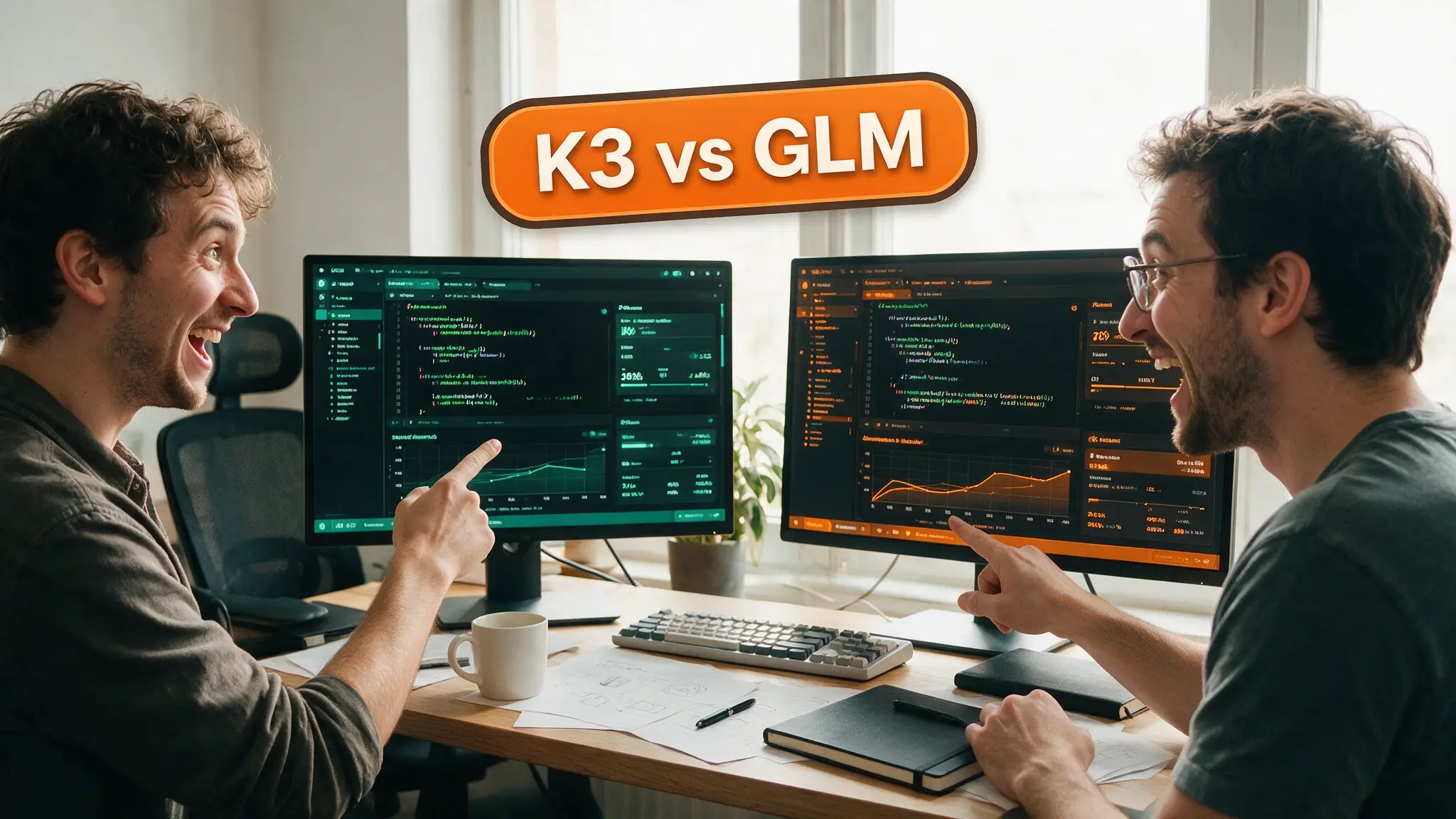
Two Chinese labs shipped frontier-class open models three days apart in mid-July, and the "which one?" question landed in our inbox almost immediately. Moonshot's Kimi K3 arrived July 16; Z.ai's GLM-5.2 topped the open-source leaderboards by July 19. We've been running open-weight models on our own hardware for two years, so here's the comparison through that lens — capability first, then the practical question nobody benchmarks: can you actually run it?
The 30-second verdict
- Kimi K3: the capability pick — stronger on nearly every published benchmark, with a decisive lead in agentic coding. But it's a 2.8-trillion-parameter monster, weights weren't downloadable at launch (promised July 27), and hosted tokens cost roughly 3x GLM's.
- GLM-5.2: the practical pick — weights available now, roughly a third of the token price, and it's the only one of the two with a realistic (if extreme) local path on prosumer hardware.
By the numbers
- 57 vs 51 on the Artificial Analysis Intelligence Index — Kimi K3 ahead of GLM-5.2 max (Artificial Analysis)
- 89.5 vs 81 on aggregate agentic-task evaluations — K3's sharpest advantage (BenchLM)
- $3.00 / $15.00 per 1M tokens (input/output) for hosted Kimi K3 vs $1.40 / $4.40 for GLM-5.2 (OpenRouter)
- 2.8T vs 744B total parameters — both sparse MoE, so active-parameter counts per token are far lower
- 91.2% GPQA Diamond / 62.1% SWE-bench Pro — GLM-5.2's headline scores, frontier-class in their own right
Capability: K3 leads, and not narrowly
The pattern across independent evals is consistent: Kimi K3 wins the hard stuff. On SWE-style software-repair benchmarks it posts leads of 14–21 points over GLM-5.2, and early aggregate rankings place it above several closed frontier models. If your workload is difficult agentic coding — multi-file repair, long tool-use chains, research agents — K3 has the stronger early profile.
The honest caveat we always apply to launch-week numbers: they're launch-week numbers. Every lab tunes for the benchmarks that headline its release. GLM-5.2's 91.2% on GPQA Diamond and 62.1% on SWE-bench Pro were themselves leaderboard-topping ten days ago. The gap is real but the field is moving monthly — treat rankings as a snapshot, not a verdict.
Price: GLM wins by 3x, and that compounds
Agentic workloads burn output tokens. At $15 per million output tokens, a busy coding agent on K3 costs real money; GLM-5.2's $4.40 changes the economics of leaving an agent running overnight. Our rule from running local vs cloud pipelines: route the hard 10% of tasks to the strongest model and the bulk 90% to the cheapest one that clears your quality bar. These two models are almost a textbook version of that split.
The local question
This is where the comparison stops being symmetric.
GLM-5.2 has a genuine — extreme, but genuine — local path. Unsloth's 2-bit dynamic GGUF compresses the 1.5TB FP16 release to about 239GB, which fits a 256GB unified-memory Mac Studio, or a single 24GB GPU with 256GB of system RAM using MoE offloading. Expect single-digit tokens per second; our full breakdown of what that actually feels like is in the GLM-5.2 local guide.
Kimi K3 weights weren't public at the time of writing (Moonshot committed to July 27), and at 2.8T parameters even aggressive quantization lands far beyond single-box territory. Realistically it's an API model for everyone without a rack.
If "runs on hardware I could own" is a requirement, GLM-5.2 wins this comparison by default — or you step down a class to something like Qwen3.6 27B or Gemma 4 12B, which trade frontier scores for interactive speeds on one GPU. Our quantization guide covers why 2-bit is even viable on these giant MoE models.
How we picked what to test
We prioritized independently published evals (Artificial Analysis, OpenRouter's model pages, aggregate leaderboards) over either lab's launch decks, cross-checked pricing on two hosts, and flagged anything we couldn't verify — K3's local footprint being the big one until weights land. We'll update this page after July 27 when the K3 weights and first community quants exist.
Which one for your use case
- Hardest agentic coding, cost secondary → Kimi K3 via API.
- High-volume agent workloads on a budget → GLM-5.2 — the capability-per-dollar pick.
- Must run on your own hardware → GLM-5.2 (2-bit, 256GB-class rig), or a smaller-class model if you want usable speed.
- Undecided → run both on OpenRouter against your own task set for an afternoon; your workload is the only benchmark that matters.
The bigger story: three days in July produced two open-weight models trading blows with closed frontier systems. Whichever you pick, the era of open weights being a tier behind is over.
Frequently asked questions
▸Is Kimi K3 better than GLM-5.2?
On raw capability, yes — Kimi K3 leads on the Artificial Analysis Intelligence Index (57 vs 51) and posts a wide margin on hard coding benchmarks. GLM-5.2 wins on price at roughly a third of Kimi's output-token cost, and its weights are downloadable today while K3's don't ship until July 27.
▸Can I run Kimi K3 or GLM-5.2 locally?
GLM-5.2 yes, with serious hardware — a 2-bit dynamic quant fits a 256GB Mac Studio or a 24GB GPU with 256GB of system RAM. Kimi K3 is a 2.8-trillion-parameter model whose weights weren't public at the time of writing; expect it to be strictly multi-node or API territory even after release.
▸How much do Kimi K3 and GLM-5.2 cost per token?
At launch, hosted Kimi K3 was listed around $3.00 input / $15.00 output per million tokens; GLM-5.2 around $1.40 / $4.40. Verify current rates on OpenRouter before committing a workload — launch pricing moves fast.
▸Which model is better for agentic coding?
Kimi K3 — its sharpest advantage is agentic work, averaging 89.5 vs GLM-5.2's 81 on aggregate agentic evaluations, and it leads clearly on SWE-style repair benchmarks. GLM-5.2 remains a very strong, much cheaper runner-up.
The 5 best AI video finds, every week
New models, tested prompts, and what actually worked in our production — one short email a week. No spam, unsubscribe anytime.
Written by Derek Holt
Local AI & Hardware Writer
Runs the site's local-inference rig and benchmarks every GPU, quant, and speed-stack claim on it personally before it goes in a guide. Will not shut up about VRAM bandwidth.
Explore these topics
Every guide, comparison and prompt library we have on each.